
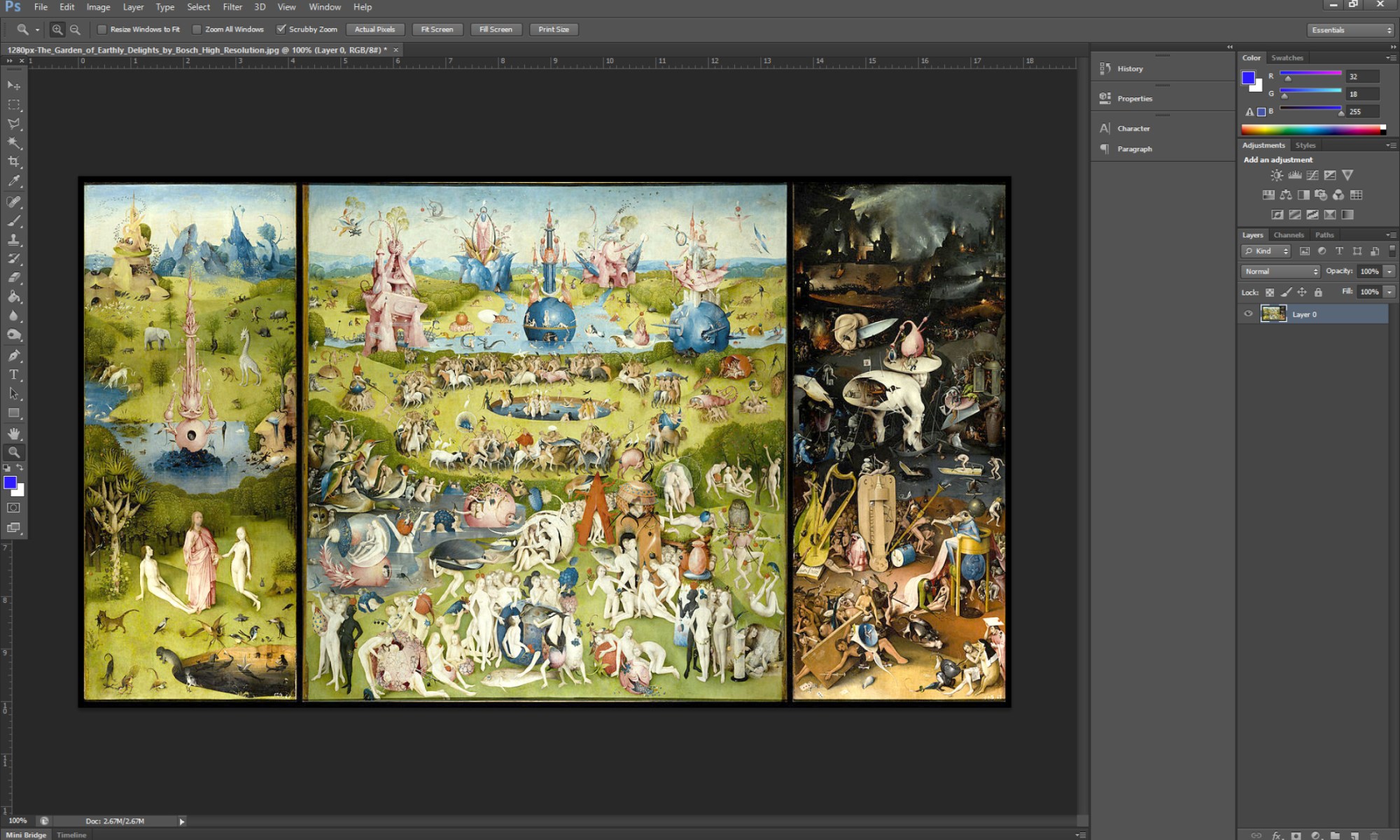
Below is an excerpt and link to an entry by Manovich into the Journal of Software Studies. The writing discusses the origins and conceptual logic of Photoshop in relation to specific commands and its organizational structure. I shared this writing with last year’s Dieste Shop.
http://computationalculture.net/inside-photoshop/
“Regardless of whether they refer to some pre-existing instrument, action, or phenomena in the physical world or not, the media techniques available in application software are implemented as computer programs and functions. Consequently, they follow the principles of modern software engineering in general. Additionally, their interfaces use established conventions employed in all application software – regardless of whether these tools are part of spreadsheet software, inventory management software, financial analysis software, or web design software. They are given extensive numerical controls; their settings can be saved and retrieved later; their use is recorded in a History window so it can be recalled later; they can be used automatically by recording and playing Actions; and so on. (The terms “History palette” and “Actions” refer to Photoshop, but the concepts behind them are found in many other software applications.) In other words, they acquire the full functionality of modern software environment – the functionality that is significantly different from that of physical tools and machines that existed previously. Because of these shared implementation principles, all application software are like species that belong to the same evolutionary family, with media software occupying a branch of the tree.15
The pioneers of media software aimed to extend the properties of media technologies and tools they were simulating in a computer – in each case, as formulated by Kay and Goldberg, the goal was to create “a new medium with new properties.” Consequently, software techniques that refer to previous physical, mechanical, or electronic tools and creative processes are also “new media” because they behave so differently from their predecessors. We now have an additional reason to support this conclusion. New functionality (for instance, multiple zoom levels, the presence of media independent techniques (copy, paste, search, etc.) and standard interface conventions (such as numerical controls for every tool, the preview option, or commands history) further separate even the most “realistic” media simulation tool from its predecessors.
This means that to use any media authoring and editing software is to use “new media.” Or, to unfold this statement: all media techniques and tools available in software applications are “new media”- regardless of whether a particular technique or program refers to previous media, physical phenomena, or a common task that existed before it was turned into software, or not.To write using Microsoft Word is to use new media. To take pictures with a digital camera is to use new media. To apply the Photoshop Clouds filter (Filters > Render > Clouds) that uses a purely automatic algorithmic process to create a cloud-like texture is to use new media. To draw brushstrokes using the Photoshop brush tool is to use new media.
In other words, regardless of where a particular technique would fall in our classification schemes, all these techniques are instances of one type of technology – interactive application software. And, as Kay and Goldberg explained in their 1977 article quoted earlier, interactive software is qualitatively different from all previous media. Over the next thirty years, these differences became only larger. Interactivity, customization, the possibility to both simulate other media and information technologies and to define new ones, processing of vast amounts of information in real-time, control and interaction with other machines such as sensors, support of both distributed asynchronous and real-time collaboration – these and many other functionalities enabled by modern software (of course, working together with middleware, hardware, and networks) separate software from all previous media and information technologies and tools invented by humans.”
 Memórias of Deep Digs